|
|---|




Saturday, March 10, 2007
Saturday Fluffernutter: Bono In The Red; Eddie In Rehab; Hendirx On The Bottle.
0 comments Posted by st at 5:00 AMAll the Fluffy news about the worlds biggest nuts
 Kenny Loggins does a rock-walk: Kenny Loggins, one half of rock duo Loggins and Messina, solo artist and successful children's singer (Return to Pooh Corner is the best children's album going) was honoured with sticking his hands in wet cement on the Hollywood RockWalk on Wednesday. " The RockWalk was established in 1985 to honor musicians who have made a significant contribution to the history of music."
No Vodka for Hendrix: The family of Jimi Hendrix, who have been stalwart in protecting the Hendrix brand since his death in 1971, are upset about Electric Hendrix Vodka(right). The family is upset, partly because alcohol was implicated in Hedrixe's death, but Seattle businessman Craig Dieffenbach "said the lawsuit has no legal basis because a 2005 federal court ruled that Experience Hendrix does not own the rights to Jimi Hendrix's name and image -- just his music."
 Next up on our touring oldies road show: Genesis has decided to re-group and do the "lucrative tour circuit," beginning with a show Sept. 7 at BMO Field in Toronto. They will be in Montreal a week later. BMO field, in case you were wondering, is the professional soccer stadium still under construction on the Exhibition grounds. Tickets go on sale this weekend.
Saving the world, one Britney at a time: Hip Hop Producer Taimbaland, who has worked with Justin Timberlake and Nelly Furtado wants to save Britney Spears career. And why?:"I feel her pain, it really bothers me... I'm the type of person who tries to save the world."
So the world has so few problems in 2007 that saving it amounts to getting a good selling album out of Britney Spears? No wonder traditional news media has been so quick with the Britney's in/Britney's out of rehab stories; the fate of the world depends on it.
FROM EDDIE
March 8, 2007
I would like Van Halen fans to know how much I truly appreciate each and every one of you. Without you there is no Van Halen.
I have always and will always feel a responsibility to give you my best. At the moment I do not feel that I can give you my best. That’s why I have decided to enter a rehabilitation facility to work on myself, so that in the future I can deliver the 110% that I feel I owe you and want to give you.
Some of the issues surrounding the 2007 Van Halen tour are within my ability to change and some are not. As far as my rehab is concerned, it is within my ability to change and change for the better. I want you to know that is exactly what I’m doing, so that I may continue to give you the very best I am capable of.
I look forward to seeing you in the future better than ever and I thank you with all my heart.
Love,
Ed

 On a serious note: Our thoughts and prayers go out to Johnny Depp and his partner, the stunning Vanessa Paradis, who are sitting bedside of their seriously ill daughter Lily-Rose at an undisclosed English hospital. As of this writing, Lily-Rose is apparently improving.
Friday, March 9, 2007
We know why Jack Layton wants bank fees reeled in, because like this ridiculous bit of trash from The Williams Lake Tribune, Jack thinks profits are obscene. But why would a long time conservative like Jim Flaherty go after the banks for ATM fees?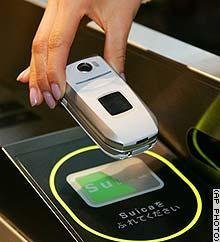 Maybe because it's a meaningless populist move. Standing up to the big nasty banks makes Jim appear soft and left-ish to rank and file middle of the road Canadians, and it's meaningless to the banks. Why is it meaningless to the banks? Because, as The Economist magazine reported last month, if cash is King, then the King is dead:
...cash, after millennia as one of mankind's most versatile and enduring technologies, looks set over the next 15 years or so finally to melt away into an electronic stream of ones and zeros. If an era is represented by its money, the information age is at hand.Which leads top the conclusion that if cash is yesterdays technology, so are ATM's. ATM fees are then, just a temporary blip, and one that a conservative like Jim Flaherty can regulate without any real long term consequence.
most of the time a phone or a smart card that can be waved over an electronic reader will beat notes and coins hands down for convenience. The doubt—and the remaining obstacle to digital money—concerns a third property of cash: its anonymity.
Information-money can be handled by any information-processing device. That includes the mobile phone, which can add to money's utility thanks to its display and its power at any time to link to your bank as a mobile ATM. Visa thinks a contactless digital transaction takes less than half the time of a cash one and that people liberated from what happens to be in their wallets spend a fifth more.
Which is why digital cash is now solving its chicken-and-egg problem. In the past shopkeepers would not install systems unless shoppers had electronic cash. And shoppers would not use electronic cash unless they had something to buy. But smart cards and readers have become cheap and consumers now possess mobile phones in droves. The trillions of payments that are too small to bear the fees of paying by credit card have come within reach and almost everyone stands to gain. Some Japanese merchants have already begun to offer discounts to people using electronic cash. Others will follow.
Note: Another article here.
 Bravo to Tim Dolighan for a great cartoon - one of many.
Thursday, March 8, 2007
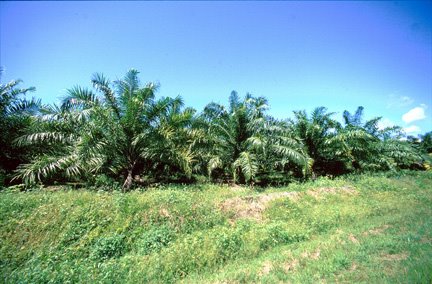
In the Netherlands Palm oil is the biofuel of choice, compared to corn here. So much so that they even built some electricity generation plants for palm oil use. It is seemingly a perfect environmental fit, as the plant grows it absorbs CO2, as it is burned it releases the CO2 it absorbed during its life-cycle. A carbon neutral fuel that is plentiful and cheap. What's not to love.
According to a New York Times article by Elisabeth Rosenthal dated January 31st, lots:
As you can imagine, this is causing a wee bit of a re-think on some subsidies and policies:Spurred by government subsidies, energy companies became so enthusiastic that they designed generators that ran exclusively on the [palm] oil, which in theory would be cleaner than fossil fuels like coal because it is derived from plants.
But last year, when scientists studied practices at palm plantations in Indonesia and Malaysia, this green fairy tale began to look more like an environmental nightmare.
Rising demand for palm oil in Europe brought about the clearing of huge tracts of Southeast Asian rainforest and the overuse of chemical fertilizer there.
Worse still, the scientists said, space for the expanding palm plantations was often created by draining and burning peatland, which sent huge amounts of carbon emissions into the atmosphere.
As a result, politicians in many countries are rethinking the billions of dollars in subsidies that have indiscriminately supported the spread of all of these supposedly eco-friendly fuels for vehicles and factories. The 2003 European Union Biofuels Directive, which demands that all member states aim to have 5.75 percent of transportation run by biofuel in 2010, is now under review...In the Netherlands, the data from Indonesia has provoked soul-searching, and helped prompt the government to suspend palm oil subsidies. The Netherlands, a leader in green energy, is now leading the effort to distinguish which biofuels are truly environmentally sound.
The government, environmental groups and some of the Netherlands’ “green energy” companies are trying to develop programs to trace the origins of imported palm oil, to certify which operations produce the oil in a responsible manner...
Beyond that, the group suggests that all emissions arising from the production of a biofuel be counted as emissions in the country where the fuel is actually used, providing a clearer accounting of environmental costs.
I offer this article neither to praise nor bury biofuels. But rather as a warning: now that Canada seems intent on running headlong into environmental activism, we need to be very careful which policies we support, and how implementation of these plans are done. We need to be sure we aren't just off loading our carbon releases to other jurisdictions.

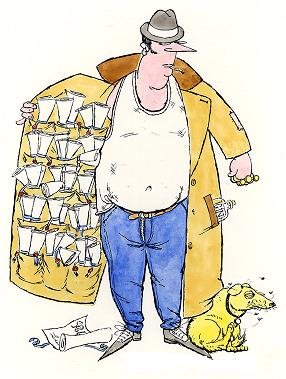 " Hey buddy- wanna buy some carbon credits?"
Wednesday, March 7, 2007
The second Canadian Kyoto report I looked at was Pain Without Gain: Canada and the Kyoto Protocol by the Canadian Manufacturers & Exporters. This one is the polar opposite of yesterdays Suzuki Foundation report, with very pessimistic, although I think far more realistic, conclusions. This report looks at Kyoto from an industry perspective almost exclusively.
It runs on a couple of base assumptions, Number one that to meet Kyoto goals energy consumption would have to decrease 4.5%/year between 2002 and 2010 - 48.6% over the 8 year period. That number assumes high amount of carbon credit purchasing. If energy use reduction is done "through domestic action alone" (i.e. no carbon purchasing), as Suzuki's report suggested was preferable and likely, then the rate of energy reduction would be 7.8/year, or 82.35% over the same 8 year period. Finally, they take the assumed range of the cost of carbon to be between $7 and $120 per tonne (at 90 mega tonnes that's between $840 million and $14.4 billion). true carbon cost is likely to be $40-$50 range, giving a true cost range of $3.6- $4.5 billion.
They also make two strong points. One, any carbon reductions due to job losses aren't true net reductions because the jobs would move, increasing carbon somewhere else. Possibly they would move to a regime with less economic regulation causing a drop in Canada's carbon release, but an increase globally. The second point is that Canada already produces 80% of it's electricity from clean sources. Many countries can change over from coal to hydro, nuclear or natural gas and achieve huge carbon savings. Canada does not have that option because a vast majority of our electrical production is already from clean sources:
Canada is more energy-intensive but less carbon0intensive than other OECD economies because of its low reliance on coal. One of the least expensive ways of reducing GHG emissions is by switching from coal to natural gas, especially in the generation of electricity.Even energy conservation measures would have very low impact because we are just conserving energy that is produced clean. This means even more of our carbon reductions must come from other sources. The report suggests a 10%-100% increase in the price of electricity, depending on province, with Alberta and Ontario being hardest hit, likely due to their increased reliance on coal. However, any increase in electricity prices would likely cause a importing of energy from the U.S. (and investment and jobs with it), that again causes Canada to off load carbon to other countries, but not reduce emissions globally:
Higher electricity costs in deregulated markets would lead to a displacement of electricity generation to less expensive jurisdictions, and most likely the displacement of emissions, investment, and jobs to the United States.In the world of gasoline, they predict a rise in the price of gasoline, in the magnitude of 80% - to $1.10 litre. Hey we're paying that now, without reducing our carbon footprint very much. I will get into my projections in a few days, but do not expect to meet Kyoto targets below $1.50 a litre, and I think that's low! Also, bear in mind that raising gas prices causes people to A) drive less or B) buy more fuel efficient vehicles. Option B is the most likely scenario, but it takes years
to work through the system: we are talking about a 2010-2012 time frame. Remember that when Stephane Dion says he can get it done in three years, even if all the components were put in place today, it will take 5-10 years for many of the processes to be effective.
The study also expects lower demand for gasoline will cause 2,000 service stations to close across Canada (all the better to compete with, my dear), and the closing of two refineries. This is where it gets interesting; those refineries would be, according to The Canadian Manufacturers and Exporters, in Ontario and Quebec or the Maritimes. Whenever some politician starts attacking the oil patch, remember the first jobs to go will be in Ontario and Eastern Canada. This makes intuitive sense, as you would expect the jobs farthest from the oil to be the most expendable, especially when you factor in the increased cost of transportation.
The study also expects steel and auto production to be hard hit (Ontario again), with an 8.2% reduction in auto production vs. business as usual projections. Furthermore an economy wide hit of 450,000 jobs is projected, many of them, of course, on Ontario and Alberta. Furthermore, it concludes, Canadians would:
I like the bit about $30,000 per household. Wonder what the polls would say if we asked "should Canada enforce Kyoto compliance if it means a $30,000 per household investment in upgrading your home?"
Drive less, drive smaller cars or take public transit that would, in turn, require massive infrastructure spending on the part of government.
Re-insulate our homes, change our furnaces, windows and appliances - at a cost that would probably average about $30,000 per household.
Pay more taxes...